
From our newsletters – snippets of information about our suburb…
INDEX:
– Wards Shoe Store
– Antonio Giannoni Sculpture
– Norwood War Memorial
– Colonist Hotel
– Woodroofe’s Soft Drinks
– Cork Tree
– Norwood Institute
– Norwood Cricket Club
– Lithuanian Hall
– Footpath Mosaics
– Hall and Sons
– War Memorial Monument (Norwood Primary School)
– Norwood Tram
– League of Historical Cities
– Cycling Velodrome
WARDS SHOE STORE
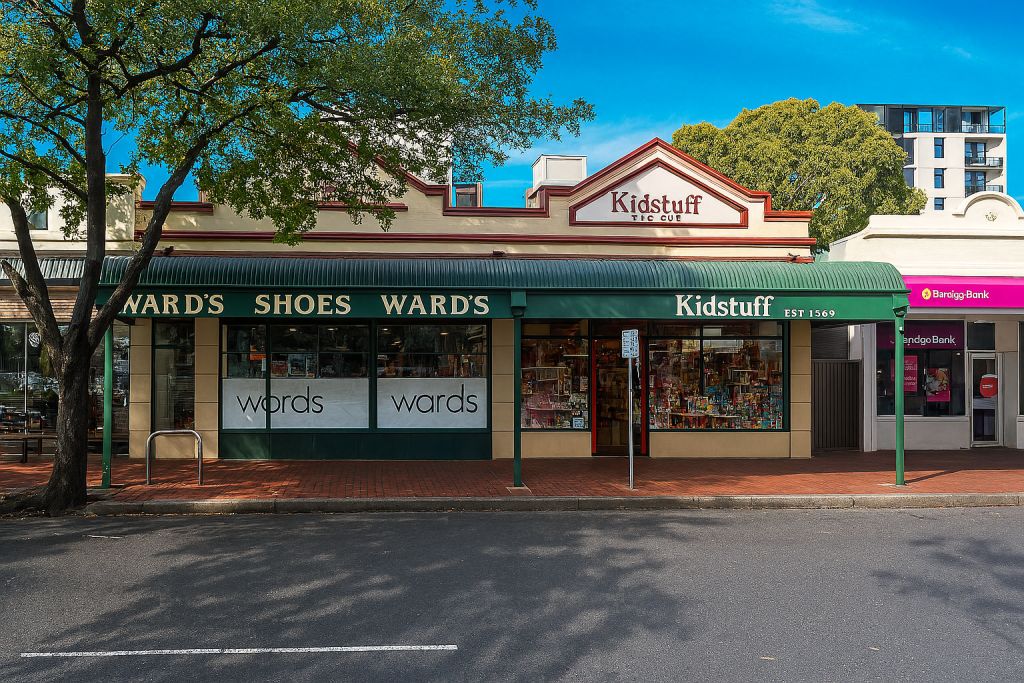
That last month we saw Ward’s Shoe Store building at 182-184 The Parade sell for $7.9 million.
The sale ended a long and remarkable chapter in the intertwined histories of the Ward and Walkley families. The shop was established in 1909 by shoemaker Alfred William Walkley and shoe retailer George Ward and operated as a family-run heritage staple for over a century. In 1922 it officially became Ward’s Shoe Store when George Ward took sole ownership. George Ward’s son, Clifford, married Alfred Walkley’s daughter, Margaret, further uniting two prominent Adelaide footwear families. Clifford Ward managed the store until 1980, when he and Margaret purchased the freehold building.
After Clifford suddenly passed away in 1980, the property was held by his children, with multiple generations working inside the classic shopfront. In 2014 the retail business operations were acquired by South Australian footwear institution Slatters Pty Ltd, though the building remained with the Ward family.
The neighbouring tenancy 182 has long been home to toy retailers including Toyworld and, more recently, Kidstuff.
The interior currently retains original timber linings and fitting benches, accompanied by official heritage plaques from the City of Norwood Payneham and St Peters. We hope that some of this character will be maintained by the local private investor who secured the historic dual-tenanted property.
< BACK
ANTONIO GIANNONI SCULPTURE
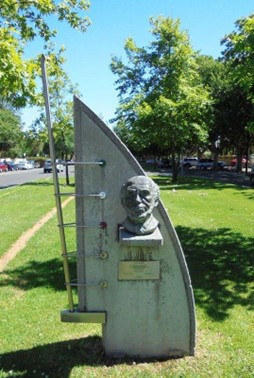
The Antonio Giannoni sculpture on Osmond Terrace, Norwood, commemorates Antonio Giannoni (1814–1883), recognised as the first Italian to settle in South Australia. Born in Rimini, Italy, Giannoni arrived in Adelaide in 1839 as a crew member on the ship the Recovery. By 1864 he had purchased a property in High Street, Kensington and operated a horse-drawn cab on the route between Adelaide and the village. He soon became a well‑known local identity. His son Peter went on to serve as Mayor of Kensington and Norwood from 1920-1922.
The bronze bust, located near the centre of Osmond Terrace, was erected to honour his contribution to the state’s early multicultural history and the significant role Italian migrants have played in shaping the local community. It was donated by the Italian Historical Society and Comune di Rimini. The sculpture was officially unveiled on 4 November 1993 as a joint initiative involving the City of Kensington and Norwood and Italian community organisations and remains an important symbol of Norwood’s cultural heritage and long‑standing Italian connections. You can find out more on Antonio Giannoni and other early Italian immigrants here: https://sahistoryhub.history.sa.gov.au/subjects/italians-in-south-australia/
< BACK
NORWOOD WAR MEMORIAL
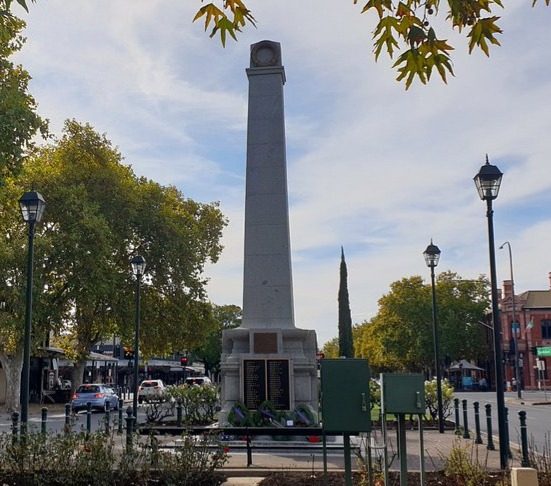
The granite obelisk at the corner of Osmond Terrace and The Parade is the
Norwood War Memorial, built to honour local men from the Kensington and
Norwood district who lost their lives in the First World War. It was created
through strong community effort, overseen by the Kensington and Norwood
Soldiers’ Memorial Committee.
The Governor, Sir Tom Bridges KCMG, joined by the Mayor William Essery,
unveiled the monument before 3000 people on 3 June 1923. The obelisk features
bronze name plaques listing the names of 183 servicemen and the enduring
inscription “Lest We Forget.” It was designed by architect Howard Culley, who
refused to take a fee for his work and instead donated it to the war fund.
The WW1 Artillery field gun located south of the memorial was manufactured by the famous German munition firm of
Fried Krupp and is a 150mm Howitzer. It was captured by the Australian Light Horse in Palestine in 1917 and after the
armistice was presented to the Kensington and Norwood Council as a war trophy.
For more than a century, the memorial has remained a focal point for the community and continues to be the site of Anzac
Day and Remembrance Day services, reminding us of Norwood’s shared history, sacrifice and respect for those who
served.
< BACK
COLONIST HOTEL
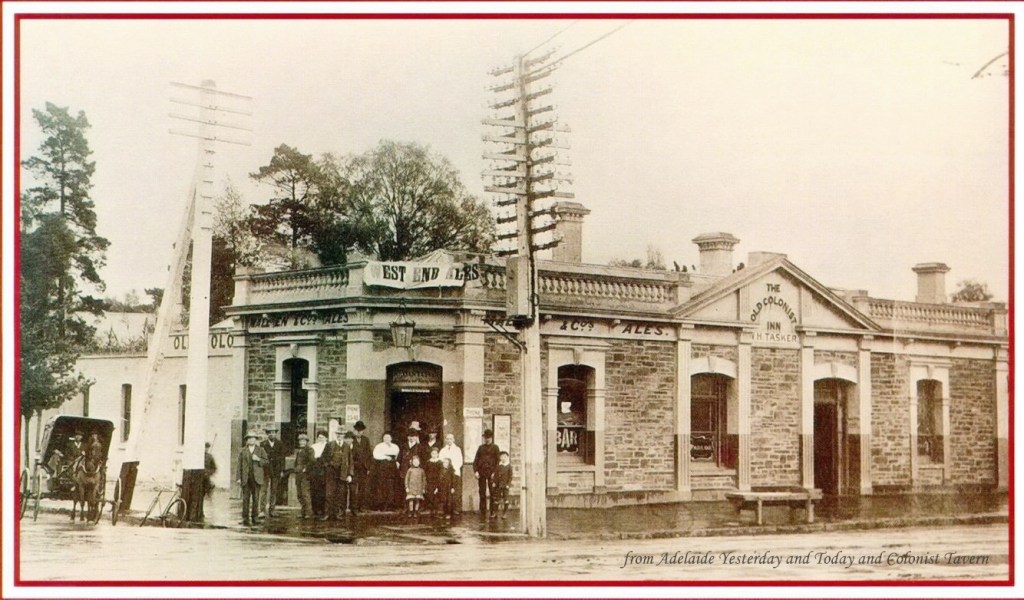
The Colonist Hotel on The Parade was originally opened in 1851 as the Old Colonist Inn — a single-storey hotel built by Frederick Hobbs, a bricklayer who, along with his wife Elizabeth, arrived on the first immigrant ship from London in early 1837. Their first daughter is recorded as the first Caucasian child born in the colony.
Frederick, however, did not enjoy a good reputation. He was reportedly a “dishevelled drunk”, an adulterer, and a convicted perpetrator of domestic violence. Even after local brewers supported Elizabeth in taking over management of the hotel, Frederick was charged with several breaches of the Publicans Act. The property was forced to be sold, leaving Elizabeth and her children to take refuge in the Destitute Asylum.
The hotel underwent major renovations in the 1870s, and a second storey was added in 1911. Over the years, The Colonist has passed through many hands. The Saturno Group (Booze Brothers) managed it for most of the early 21st century, before selling to the current owners, Australian Venue Co., in 2021. The Colonist was added to the local heritage register in 2000.
< BACK
WOODROOFE’S SOFT DRINK COMPANY
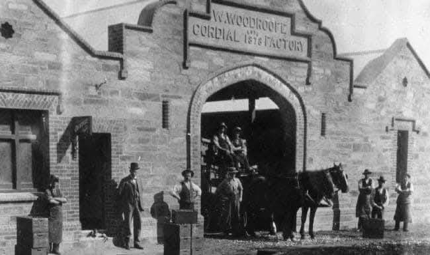
That the Woodroofe’s soft drink company started here in Norwood? William Woodroofe and Bruce Randall founded the business in 1878. The factory was sited at a natural spring, which was the source of water for the firm’s products. Woodroofe’s best known and most popular flavour is lemonade, advertised for many years with the slogan and jingle “Still the best lemonade made”. Generations of South Australian mothers gave their sick children boiled Woodroofe’s lemonade under medical advice. Woodroofe operated as a family company for over a century before it changed hands several times eventually leading to the present owners, Asahi/Schweppes, with production moved to Melbourne and Perth. The original Norwood factory in Theresa St, now part of U-Store-It, is State heritage listed.
< BACK
CORK TREE
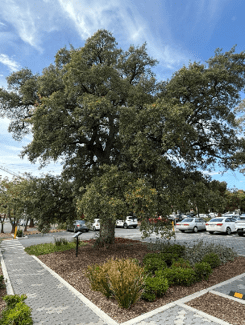
That there is a Portuguese cork tree in the Edward St car park of the Coles complex? This was planted at the residence of Henry Buttery in 1892 who lived at the house at 74 Edward St. Henry was a prominent businessman who was a furniture manufacturer and also built the still existing shops at 158-166 The Parade. Cork trees can have a lifespan of 200-400 years, and this one is believed to be among the oldest in Australia. Since the demolition of the house in 1977 there has been pressure to remove this (and other trees) but at least this one has escaped the axe. This is in no small part due to actions of concerned residents – particularly with the most recent redevelopment when the original plans threatened to remove the tree. There is actually a website and Facebook page dedicated to the tree and its history. Go to https://thenorwoodcorktree.blogspot.com/ to find out more. In recent times an information board has been installed with the above history.
< BACK
NORWOOD INSTITUTE
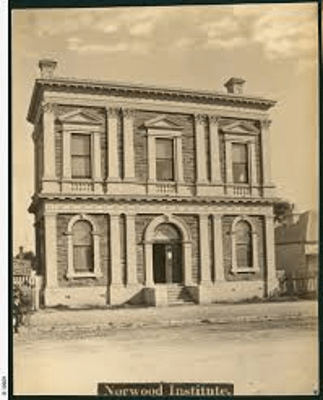
That the current Norwood Library was originally the Norwood Institute? What is an “Institute”? In June 1856 the South Australian Institute Act was established to ‘promote the general study and cultivation of all or any of the various branches of . . . art, science, literature and philosophy’ in the colony. Thus, they were early centres of learning and served as community libraries.
Mayor E.T. Smith formed a committee in 1872 to build the Norwood Institute – initially envisaged to occupy the large corner on The Parade and Osmond Terrace but scaled back due to insufficient funds. First providing a small library in 1877, it was formerly opened by Governor Robinson in 1883 with a concert performed by students of the Model School (now Norwood Primary School).
The style of the building is typical of its day. Unfortunately, the cast-iron fence and gates were removed during the Second World War for a scrap iron drive.
Eventually, with dwindling membership, the property was transferred to the Council in 1977 and later refurbished to become the Norwood Library of today.
If you want to learn more about Institutes of South Australia, there’s a great website: https://institutessa.com/
< BACK
NORWOOD CRICKET CLUB
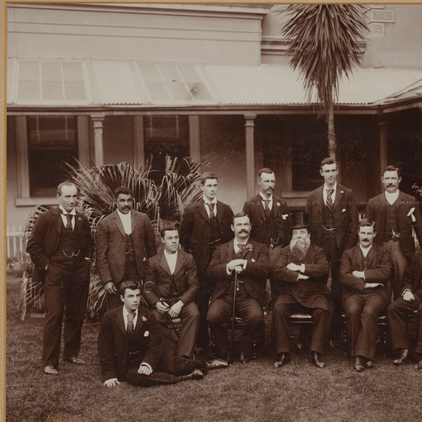
that Norwood had one of the earliest and most successful cricket clubs?
In 1865, the Norwood Cricket Club was formed, boasting an impressive 32-year run with only 64 losses. During this period, the club dominated the Cricket Association’s challenge cups and trophies, winning all six presented.
Norwood played a pivotal role in establishing the South Australian Cricket Association. On May 9, 1871, a meeting was held where Mr. W.O. Whitridge proposed communicating with prominent clubs to discuss forming a cricket association. This led to the inaugural meeting at the Prince Alfred Hotel, with Mr. J. Pickering as the first secretary. Mr. Whitridge chaired the association for three years, driving the movement forward.
Two notable members of the club – George Giffen and J.J. Lyons, went on to achieve international fame. Local cricket legend J.E. Gooden captained the team for 16 years and led a ‘Colonial 18’ against Lord Harris’s English Eleven. In the 1880s, East and West Norwood teams emerged, with West Norwood achieving a remarkable victory by dismissing Parkside for just five runs. The club eventually disbanded in 1897 with the introduction of the electorate system, paving the way for East Torrens to rise in its place.
< BACK
LITHUANIAN HALL
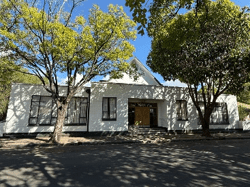
that the locus of the Adelaide Lithuanian community is in Eastry St Norwood? After WWII many peoples of the Baltic states (Estonia, Lithuania & Latvia) immigrated to Australia to escape the Soviet occupations. A considerable number of these established themselves in Adelaide, leading to the development of community centres. These centres served as vital meeting places for residents, fostering connections and cultural exchange. Originally a Methodist church, the Norwood property was purchased in 1957 with additions made in the following years. It remains a focal point for the Lithuanian community with regular Sunday meals, cooking classes and cultural events. Go along sometime and perhaps sample their famous dish of Cepelinai – large, potato-based dumplings, traditionally stuffed with meat, cheese, or vegetables. To learn a little more about their history, go to: https://sahistoryhub.history.sa.gov.au/places/lithuanian-house/
< BACK
FOOTPATH MOSAICS
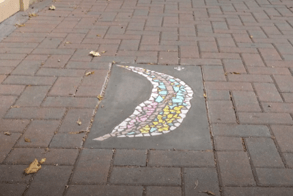
That the mosaics in the footpaths near and leading to the Norwood Primary School were part of a project instigated by the school, the Council and the Department for Infrastructure and Transport (through their Way2Go program) to encourage students to walk or ride to school, perhaps by a circuitous route. A local artist, Helen Crawford, was engaged to guide the students who made the leaf mosaics themselves. They were then laid around the streets by the Council (around 6-7 years ago). You can watch a video of the whole process at: https://www.youtube.com/watch?v=K3w4gtiZKj8
< BACK
HALLS AND SONS
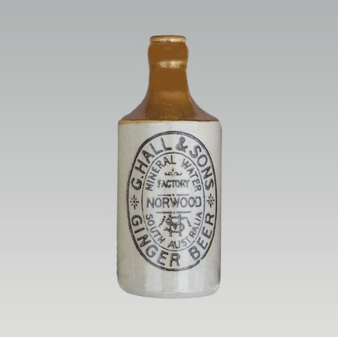
That the Services Australia/Centrelink building on Edward St was once the home to Halls Soft Drinks? In fact, even before they moved there in 1872 from their initial base in Marryatville it was a soap and candle factory. Part of the reason for the move was to take advantage of the natural spring water available. After success in the Sydney International Exhibition of 1879, they entered six products in the 1880 International Exhibition in London and won six first prizes.
“Messrs. Hall & Sons (of Norwood) Aerated Waters are pronounced to be a
most extraordinary success, and have completely defeated all the European,
American and Australian exhibits in all the six kinds exhibited. Every Water
shown by Hall & Sons obtained a first class prize. The judges expressed great
astonishment, and attributed the results to the supremacy of the Adelaide
water.”
Geo Hall & Sons continued manufacturing there well into the 20th century. They were taken over by Coco Cola in 1972 and were discontinued in 2000. We’re not sure when manufacturing ceased in Norwood only that the Orange Lane Market operated from those premises from 1991. In 2023 the Ballard family announced they were re-introducing the Halls brand so you can once again get your fix of Fruita, Lemon Twist or the classic Lemonade (all on the shelf in Norwood Foodland).
Passiona has yet to be revived!
< BACK
WAR MEMORIAL MONUMENT (Norwood Primary School)
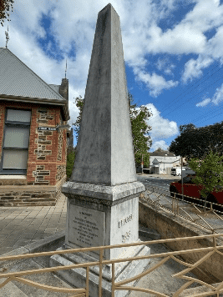
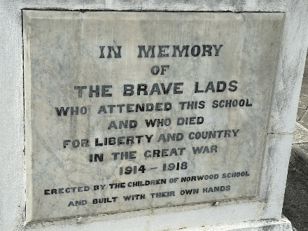
That the War Memorial Monument on the corner of Osmond Terrace and Beulah Road and within the Norwood Primary School grounds was built in part by the school’s students? The headmaster of the time, Joseph Kennedy, whose own son was severely wounded in WW1, designed the obelisk himself and organised the fund raising to pay for it. The campaign became known as “Pennies for bricks” where the student paid one penny per brick and got to lay the bricks themselves. Along with help from staff, parents and others it was completed in 1918 although never formally launched. The monument commemorates students at the school who died in service or in action during World War One and World War two.
< BACK
NORWOOD TRAM
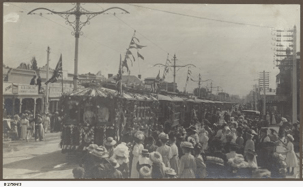
That the very first street public transport in Adelaide was to Norwood (and Kensington)? Initially this was by way of horse drawn trams from 1878 with tracks along The Parade. It was converted to an electric system in 1909 – the picture (courtesy of The State Library) is of the opening of the electric tramline with the first tram driven by a Mrs Price. The line finally closed in 1957.
It was a Labor Party policy in 2018 to re-introduce trams down The Parade but as we all know they failed to get re-elected, and the plan was shelved. Although popular at first with our residents, they were less enthusiastic when learning it would have involved the removal of all those nice Ironbark trees down the centre of The Parade
< BACK
LEAGUE OF HISTORICAL CITIES
That Norwood, Payneham and St Peters is a member of the LEAGUE OF HISTORICAL CITIES? We are one of 128 in the world and one of only three in Australia (the others being Melbourne and Ballarat). The league was founded in Kyoto, Japan in 1994 and as part of its charter: “The League … acts as a think tank for bilateral cooperation, mutual learning and best practices. It aims to strengthen affiliations between historic cities to exchange knowledge, deepen mutual understanding and build on the common foundations.”. You can find out more about the organisation at: https://www.lhc-s.org/
< BACK
CYCLING VELODROME
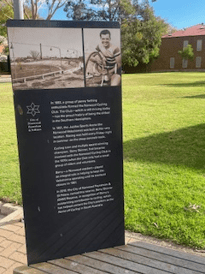
That Norwood once had a cycling velodrome? The Jubilee Cycling Arena – the first in the state in fact. Built in 1951 on Osmond Terrace, races were held every Friday night. It was even used for square dancing in the fifties! The Norwood Cycling Club – still going strong after 140 years and the oldest in the Southern Hemisphere – managed the velodrome for almost 30 years. No surprise though that it eventually got sold off by the Council to developers in 1981. In recognition of Norwood resident and cycling champion Barry Skinner (OAM) who played a major role in the operation of the velodrome, the Council named the reserve on Appelbee Crescent after him.
< BACK

